
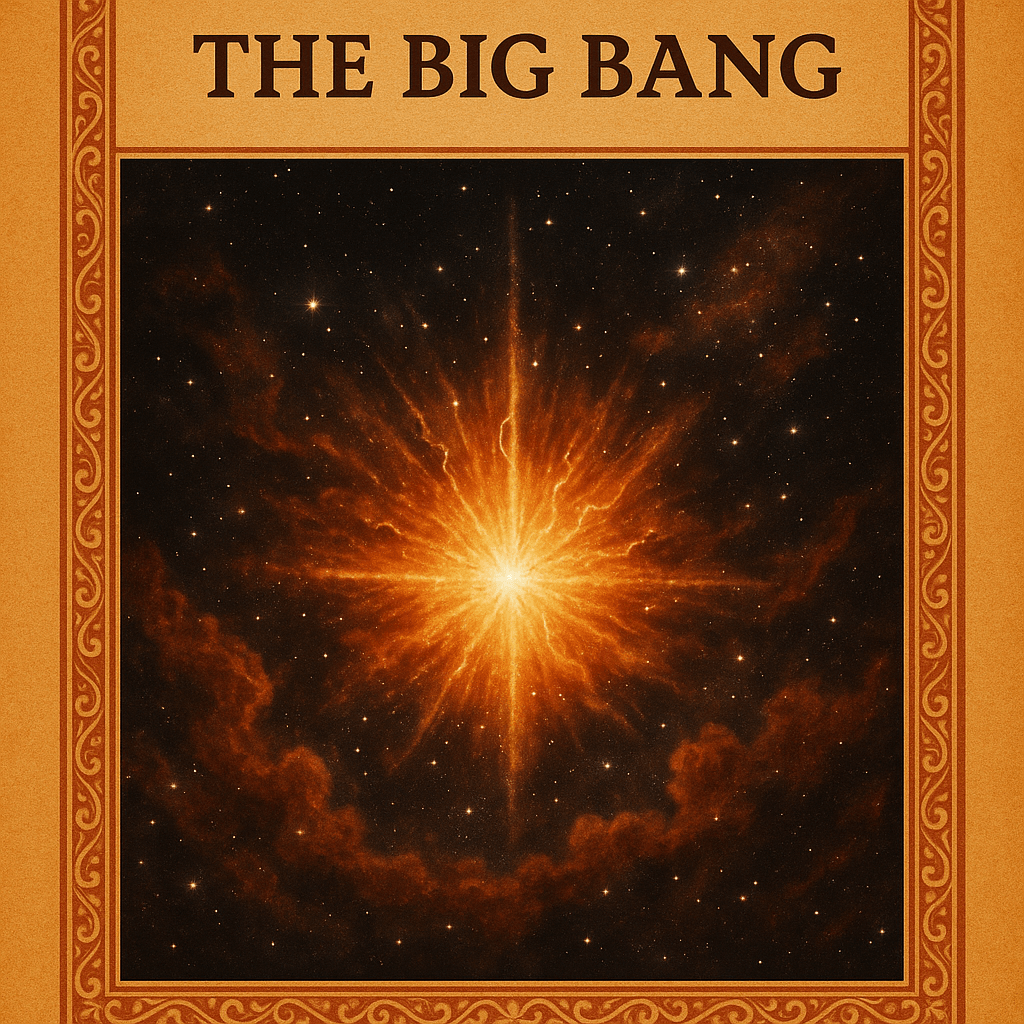
Did Ancient Indian Texts Predict the Big Bang?
The Big Bang Theory is the leading explanation of how our universe began. But did ancient Indian texts — written thousands of years ago — already hint at this cosmic origin? Surprisingly, many scriptures like the Rigveda, Upanishads, and Puranas contain strikingly similar descriptions of how the universe came into being.
Did ancient Indian sages intuit the secrets of the universe long before modern science? Long before the Big Bang theory emerged in astrophysics, Indian scriptures like the Rigveda and Puranas spoke of cosmic eggs, endless cycles of creation, and the mysterious origins of existence. In this article, we explore the fascinating philosophical parallels between ancient Hindu cosmology and contemporary scientific thought — revealing a profound connection between ancient wisdom and the universe’s ultimate beginning.
Click here to read about the Big Bang Theory in detail
1. The Nasadiya Sukta – Creation Out of Nothing
Found in Rigveda 10.129, the Nasadiya Sukta (Hymn of Creation) describes the moment before creation:
“Then even nothingness was not, nor existence… That One breathed, windless, by its own impulse.”
This mystical verse mirrors modern scientific ideas of the singularity — a state before time, matter, and space began.
Click here to read:Distance of the Sun from earth was known in India thousands of years before ?
2. The Cosmic Egg – Brahmanda in Puranas
The Vishnu Purana and other ancient texts mention a golden egg, or Brahmanda, from which the universe was born. This cosmic egg expanded — much like the universe did after the Big Bang.
3. Hinduism’s Cyclic Universe vs. Linear Time
Unlike modern science’s one-time explosion theory, Hindu texts speak of eternal cycles of creation and destruction:
- Srishti (Creation)
- Sthiti (Preservation)
- Pralaya (Dissolution)
This cyclical view aligns with modern ideas like the Oscillating Universe and Multiverse theories.
4. Time Scales that Match Modern Astronomy
Hindu scriptures describe cosmic timescales in billions of years — Kalpas and Yugas — astonishingly close to modern cosmology’s age of the universe (~13.8 billion years).
Click here to read How mantras can heal us
5. Matter and Consciousness – Samkhya Philosophy
In Samkhya, the universe is born when Prakriti (primordial matter) is disturbed by Purusha (pure consciousness). This can be symbolically linked to quantum fluctuations that triggered cosmic inflation.
Conclusion: Wisdom Beyond Time
While the ancient Indian texts do not describe the Big Bang in scientific terms, their poetic and philosophical insights show a deep understanding of the cosmos — perhaps more advanced than we once believed. The parallels between ancient Indian cosmology and modern science continue to inspire scholars and seekers alike.
🌐 Further Reading
Tags:
Big Bang in Hinduism, Cosmic Egg theory, Brahmanda, Nasadiya Sukta, Hindu cosmology, Vedas and science, Vishnu Purana, Ancient Indian astronomy, Kalpa time scale, Pralaya, Hindu view on universe creation
 Gyan granth