Welcome to WordPress. This is your first post. Edit or delete it, then start writing!
Category: Uncategorized
-
What Is the Big Bang Theory? Simple Explanation for Everyone
What Is the Big Bang Theory? Simple Explanation for Everyone
Discover how the universe began and what the Big Bang Theory really means in everyday language.
🌌 The Birth of the Universe

The Big Bang Theory explains how the universe began from a very small, hot, and dense point about 13.8 billion years ago. It wasn’t an explosion but an expansion of space itself, and everything in the universe today came from that moment.
🔥 What Happened After the Big Bang?

- The universe was extremely hot and filled with energy.
- Basic particles like protons and neutrons formed.
- As it cooled, atoms like hydrogen and helium began to appear.
- Click here to read https://gyangranth.co.in/2025/05/23/brahmanda-to-big-bang-how-hindu-texts-echo-modern-science/
💡 When Did Light Begin?

Around 380,000 years after the Big Bang, the universe cooled enough for light to travel freely. This light, known as the Cosmic Microwave Background (CMB), is still detectable today and serves as a “snapshot” of the early universe.
🌠 How Stars and Galaxies Formed

Over millions of years, gravity pulled atoms together to form stars and galaxies. Inside stars, heavier elements formed, which eventually created planets — including our own Earth.
🔍 Key Evidence Supporting the Big Bang Theory
- Expanding Universe: Distant galaxies are moving away from us.
- Cosmic Microwave Background: Light from the early universe still exists.
- Element Abundance: The amounts of hydrogen and helium match predictions.
🧠 Final Thoughts
The Big Bang Theory helps us understand where everything came from and how the universe has changed over billions of years. It’s not just history — the universe is still expanding, and we’re part of that incredible story.
❓ FAQs
Was there anything before the Big Bang?
Scientists don’t have a clear answer. Some believe time started with the Big Bang; others explore ideas like multiverses or quantum beginnings.
Is the Big Bang Theory proven?
It’s the most widely supported explanation based on evidence, but science always leaves room for new discoveries and better understanding.
© 2025 gyangtanth. All rights reserved.
-
“Brahmanda to Big Bang: How Hindu Texts Echo Modern Science

Did Ancient Indian Texts Predict the Big Bang?
The Big Bang Theory is the leading explanation of how our universe began. But did ancient Indian texts — written thousands of years ago — already hint at this cosmic origin? Surprisingly, many scriptures like the Rigveda, Upanishads, and Puranas contain strikingly similar descriptions of how the universe came into being.
Did ancient Indian sages intuit the secrets of the universe long before modern science? Long before the Big Bang theory emerged in astrophysics, Indian scriptures like the Rigveda and Puranas spoke of cosmic eggs, endless cycles of creation, and the mysterious origins of existence. In this article, we explore the fascinating philosophical parallels between ancient Hindu cosmology and contemporary scientific thought — revealing a profound connection between ancient wisdom and the universe’s ultimate beginning.
Click here to read about the Big Bang Theory in detail
1. The Nasadiya Sukta – Creation Out of Nothing
Found in Rigveda 10.129, the Nasadiya Sukta (Hymn of Creation) describes the moment before creation:
“Then even nothingness was not, nor existence… That One breathed, windless, by its own impulse.”
This mystical verse mirrors modern scientific ideas of the singularity — a state before time, matter, and space began.
Click here to read:Distance of the Sun from earth was known in India thousands of years before ?
2. The Cosmic Egg – Brahmanda in Puranas
The Vishnu Purana and other ancient texts mention a golden egg, or Brahmanda, from which the universe was born. This cosmic egg expanded — much like the universe did after the Big Bang.
3. Hinduism’s Cyclic Universe vs. Linear Time
Unlike modern science’s one-time explosion theory, Hindu texts speak of eternal cycles of creation and destruction:
- Srishti (Creation)
- Sthiti (Preservation)
- Pralaya (Dissolution)
This cyclical view aligns with modern ideas like the Oscillating Universe and Multiverse theories.
4. Time Scales that Match Modern Astronomy
Hindu scriptures describe cosmic timescales in billions of years — Kalpas and Yugas — astonishingly close to modern cosmology’s age of the universe (~13.8 billion years).
Click here to read How mantras can heal us
5. Matter and Consciousness – Samkhya Philosophy
In Samkhya, the universe is born when Prakriti (primordial matter) is disturbed by Purusha (pure consciousness). This can be symbolically linked to quantum fluctuations that triggered cosmic inflation.
Conclusion: Wisdom Beyond Time
While the ancient Indian texts do not describe the Big Bang in scientific terms, their poetic and philosophical insights show a deep understanding of the cosmos — perhaps more advanced than we once believed. The parallels between ancient Indian cosmology and modern science continue to inspire scholars and seekers alike.
🌐 Further Reading
Tags:
Big Bang in Hinduism, Cosmic Egg theory, Brahmanda, Nasadiya Sukta, Hindu cosmology, Vedas and science, Vishnu Purana, Ancient Indian astronomy, Kalpa time scale, Pralaya, Hindu view on universe creation
-
World Turtle Day 2025: Celebrate, Protect, and Raise Awareness
World Turtle Day 2025: Celebrate, Protect, and Raise Awareness
Date: May 23, 2025

Image Source: Freepik
World Turtle Day is observed annually on May 23rd to raise awareness about turtles and tortoises and encourage actions to help them survive and thrive in their natural habitats.
History of World Turtle Day
Established in 2000 by the American Tortoise Rescue, World Turtle Day aims to celebrate these reptiles and promote their conservation worldwide.
Why Turtles Matter
Turtles play a crucial role in maintaining the health of aquatic ecosystems. As both predators and prey, they help balance food webs and contribute to the biodiversity of their habitats.
Threats Facing Turtles
- Habitat Destruction: Urban development and deforestation reduce nesting and feeding areas.
- Pollution: Plastic waste and oil spills contaminate their environments.
- Climate Change: Alters sex ratios in hatchlings and affects migration patterns.
- Illegal Trade: Poaching for shells, meat, and the pet trade endangers populations.
How You Can Help
- Reduce Plastic Use: Opt for reusable bags, bottles, and straws to minimize ocean pollution.
- Support Conservation Efforts: Donate to or volunteer with organizations dedicated to turtle protection.
- Educate Others: Share information about turtle conservation on social media and in your community.
- Participate in Beach Cleanups: Removing trash from shorelines prevents ingestion and entanglement.
Celebrate World Turtle Day by taking action to protect these incredible creatures. Every effort counts in ensuring their survival for generations to come.
Image Source: Vecteezy
Join the Movement
For more information and resources, visit the official World Turtle Day website.
-
May 21: National Anti-Terrorism Day 2025: Significance, History & Pledge

🕊️ What is National Anti-Terrorism Day?
Every year on May 21, India observes National Anti-Terrorism Day to honor the memory of former Prime Minister Rajiv Gandhi, who was assassinated on this day in 1991. The day also serves as a reminder of the devastating impact of terrorism on human life and the importance of standing united against violence.
📜 History of National Anti-Terrorism Day: Why May 21
National Anti-Terrorism Day was established in 1992 by the Indian government after the brutal assassination of Rajiv Gandhi by a suicide bomber from the LTTE (Liberation Tigers of Tamil Eelam) during an election campaign in Sriperumbudur, Tamil Nadu.

This observance is not only about commemorating a tragic moment in Indian history but also about reaffirming our commitment to peace, unity, and non-violence.
Click here to read everything about the assassination of Rajiv Gandhi https://gyangranth.co.in/2025/05/20/assassination-of-rajiv-gandhi-history-facts-and-legacy-of-a-tragic-day/
🎯 Objectives of National Anti-Terrorism Day

- To spread awareness about the threat of terrorism
- To educate youth on the dangers of extremism
- To promote harmony and peace in society
- To commemorate all victims of terrorism
🏛️ How to celebrate National Anti Terrorism Day
- Pledge ceremonies in schools and offices
- Awareness rallies and poster competitions
- Public discussions and educational seminars
- Social media campaigns promoting peace
🧾 The Anti-Terrorism Pledge:
One of the key parts of this day is reciting the national pledge, which includes:
“We, the people of India, having abiding faith in our country’s tradition of non-violence and tolerance, hereby solemnly affirm to oppose with our strength, all forms of terrorism and violence…”
🛑 Why National Anti-Terrorism Day Matters Today

Pahalgam:Beauty destroyed by terror attack
In the modern era, terrorism remains a global issue. Events like the 26/11 Mumbai attacks, Pulwama, the recent Pahalgam incident leading to war between India and Pakistan and global terror threats highlight the need for consistent vigilance and a united stand against hate-driven violence.
This day encourages every citizen, especially students and youth, to become aware, alert, and active in maintaining peace and security.
📝 Final Thoughts
National Anti-Terrorism Day is more than just a remembrance of the past—it’s a call to action for a peaceful future. As responsible citizens, it’s our duty to spread awareness, promote unity, and stand firmly against terrorism in all its forms.
-
Assassination of Rajiv Gandhi: History, Facts, and Legacy of a Tragic Day
📅 What Happened on May 21, 1991?
On the evening of May 21, 1991, India lost one of its most promising leaders — former Prime Minister Rajiv Gandhi — in a brutal suicide bombing in Sriperumbudur, Tamil Nadu. This assassination shocked the entire nation and altered the course of Indian political history.

👤 Who Was Rajiv Gandhi?
Rajiv Gandhi was born on August 20, 1944, into India’s most powerful political family. He became India’s youngest Prime Minister at age 40, after the assassination of his mother, Indira Gandhi, in 1984.

Rajiv Gandhi with his wife Sonia Gandhi
His tenure was marked by:
- Major advances in telecommunications
- Efforts toward modernization and liberalization
- Initiatives for youth empowerment and education reform
However, his leadership was also marred by controversy, including the Bofors scandal and challenges in foreign policy.
💣 How Was Rajiv Gandhi Assassinated?
During an election campaign in Sriperumbudur, Rajiv Gandhi was greeting supporters when a woman named Dhanu, a member of the Liberation Tigers of Tamil Eelam (LTTE), approached him. She bent to touch his feet and detonated an explosive belt tied around her waist.
The impact:
- Rajiv Gandhi and 14 others were killed instantly
- Many others were injured in the blast
- This was India’s first political suicide bombing

⚖️ Who Was Behind the Assassination?
Investigations by the CBI and SIT concluded that the LTTE, a Sri Lankan Tamil militant group, carried out the assassination. The LTTE was angry with Rajiv Gandhi for sending the Indian Peace Keeping Force (IPKF) to Sri Lanka during his tenure.
In 1998, 26 people were convicted in connection with the case. However, legal battles over the years led to:
- Several sentences being commuted
- Ongoing debates over the release of convicts
🕍 Rajiv Gandhi Memorial in Sriperumbudur
The Rajiv Gandhi Memorial, located at the site of the assassination, was built to honor his memory. The memorial features:
- A lotus-shaped platform
- Seven pillars representing India’s major religions
- A peaceful garden attracting thousands of visitors annually

🕯️ Legacy of Rajiv Gandhi and His Assassination
Rajiv Gandhi’s assassination was a turning point in India’s fight against terrorism and political violence. It led to stronger security protocols for political leaders and greater public awareness about the risks of extremism.
His legacy includes:
- Rajiv Gandhi Khel Ratna Award
- Technological reforms
- Efforts toward digital India’s early foundation
- National Anti Terrorism Day is observed on May 21
- Click here to read about National Anti Terrorism Day
- https://gyangranth.co.in/2025/05/20/may-21-national-anti-terrorism-day-2025-significance-history-pledge/
📌 Conclusion
The assassination of Rajiv Gandhi remains one of the darkest chapters in India’s modern political history. It reminds us of the cost of violence, the importance of democratic values, and the ever-present need for national unity.
🔖 FAQs
Q1: Who killed Rajiv Gandhi?
A: The suicide bomber was Dhanu, affiliated with the LTTE, a Sri Lankan Tamil militant organization.Q2: Where was Rajiv Gandhi assassinated?
A: In Sriperumbudur, near Chennai, Tamil Nadu.Q3: Why did LTTE kill Rajiv Gandhi?
A: In retaliation for his support of the Sri Lankan government through the Indian Peace Keeping Force (IPKF) mission. -
The real Elephant Whisperer: A beautiful relationship between a man and elephants.

In today’s world nobody remembers anyone else’s good deeds towards them. We humans have become so ungrateful that after a little time we forget the ones who have helped us. But would you believe if I say that animals are more grateful than us. They not only remember the person who helped them but also pay tribute to them. Yes, this is true and you will also believe it when you will come to know about Lawrence Anthony.
Who is Lawrence Anthony

Born in South Africa (born on 17 September 1950) Lawrence Anthony was a conservationist and environmentalist. He was the founder of the Thula Thula game reserve in Zululand and was well-known for his work in wildlife rehabilitation and conservation.
Anthony was a vocal advocate for wildlife conservation and often spoke out against poaching and other threats to endangered species. He also founded the Earth Organization, a non-profit environmental group that focused on conservation and education.
Anthony’s experiences with the elephants formed the basis of his book “The Elephant Whisperer,” which became a best-seller and brought attention to the plight of elephants in Africa. Due to his special connection with elephants he was known as the “Elephant Whisperer”. How he rescued and rehabilitated the herd of traumatized elephants at his Thula Thula game reserve in Zululand, South Africa is still and inspiration and great example.
Relation with Elephants

It all started in 1999 when Anthony was asked to take in a herd of wild elephants that had been deemed too dangerous and were going to be culled. Instead of accepting their fate, Anthony took in the elephants and began to work with them using his unique approach of understanding their behaviour and communicating with them.
Over time, Anthony not only gained the trust of the elephants but also established a deep bond with them. He spent hours observing their behaviour and learning how to communicate with them through body language and vocalizations.
Death


In March 2012 when Lawrence Anthony died people observed something very strange. A group of wild elephants travelled to his home in Thula Thula reserve. This was remarkable because it had been more than 1 year that the elephants have been to his house. They arrived at his house shortly after his death and stayed there for two days, without any food or water. They stood outside his home in a silent vigil, as if mourning his passing.
This incident left everyone awestruck. It highlighted how these animals have intelligence and emotional depth and their ability to show compassion and empathy towards humans.

The elephants’ visit was seen as a fitting tribute to Lawrence Anthony, who devoted his life to the protection and conservation of wildlife, particularly elephants. His legacy continues to inspire many people around the world to work towards protecting these magnificent animals and their habitats.
This incident proves how wrong we are when we use the term “animal” in negative sense to show someone cruel or uncompassionate. The respect and compassion shown by animals in this case has left us speechless.
-
Can Mantras actually heal us: Scientific explanation
With growing interest of many people in Indian Yoga and Meditation you might have heard them talking about the power of Mantras. In fact there are many people who experience inner peace and calmness by reciting or simply listening to some mantras. What exactly is this effect of Mantras. Is it purely a placebo effect or is there any science behind it ? Let’s dig deeper into this.
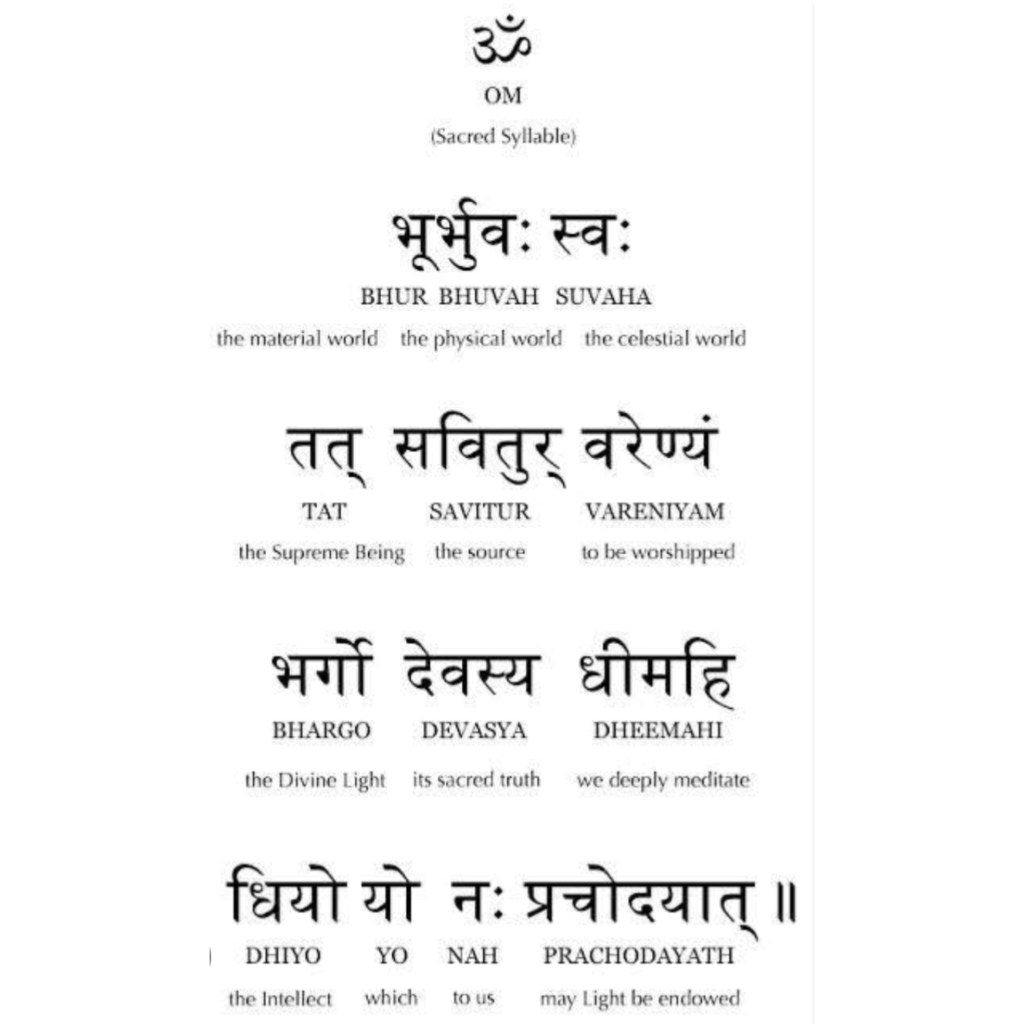
Gayatri Mantra What is a Mantra ?
Before discussing the power or the effect of Mantra first we need to know what a Mantra is. A Mantra is a word or a prayer, mostly in Sanskrit, that is chanted or sung. It might be as simple as a single word Om (Aum)( ॐ) or a set of rhythmic words and phrases like the Gayatri Mantra. A mantra is repeated multiple times (mostly 108) by people. Most mantras dates back to the Vedic period (1500-500 BCE) or even older.
How Mantras affect us ?
Well on the surface it appears that reciting mantras is a religious thing only. But if you go deeper, you will realize their power. But before that we have to understand one very basic fact about human bodies. Firstly, that the heartbeat and breathing are interconnected. The oxygen required by our body is directly proportional to the rate at which our heart beats. For example, when a person exercises, muscles need energy for movement. To provide this energy heart have to beat faster to pump more oxygen. In simple terms, as the heart beats faster, it uses more energy and sends more oxygen to the body.
Now, excersice is a very positive example. If we observe statistically heartbeat of individuals mostly increases due to wrong and negative reasons. It might be due to stress, age, bad fitness level, illness etc. Prolonged increased heart rate might result in cardiovascular deseases or a heart attack.
If you notice any mantra, it is rythemic. When we chant the same mantra repeatedly it sets our breathing pattern in a certain manner. When breathing is happening in a set manner it directly affects our heartbeat. A balanced breathing pattern and heartbeat togather give a feeling of relaxasation and calmness.
Effect of Mantras on the Universe?
It is often said that if you are going through tough times chanting certain Mantras will help you. Mantras have effect on our bodies and help keep us calm is understandable but Can recitation of mantra bring about a change in our environment? How is this possible? To understand this we need to understand some basic scientific facts.
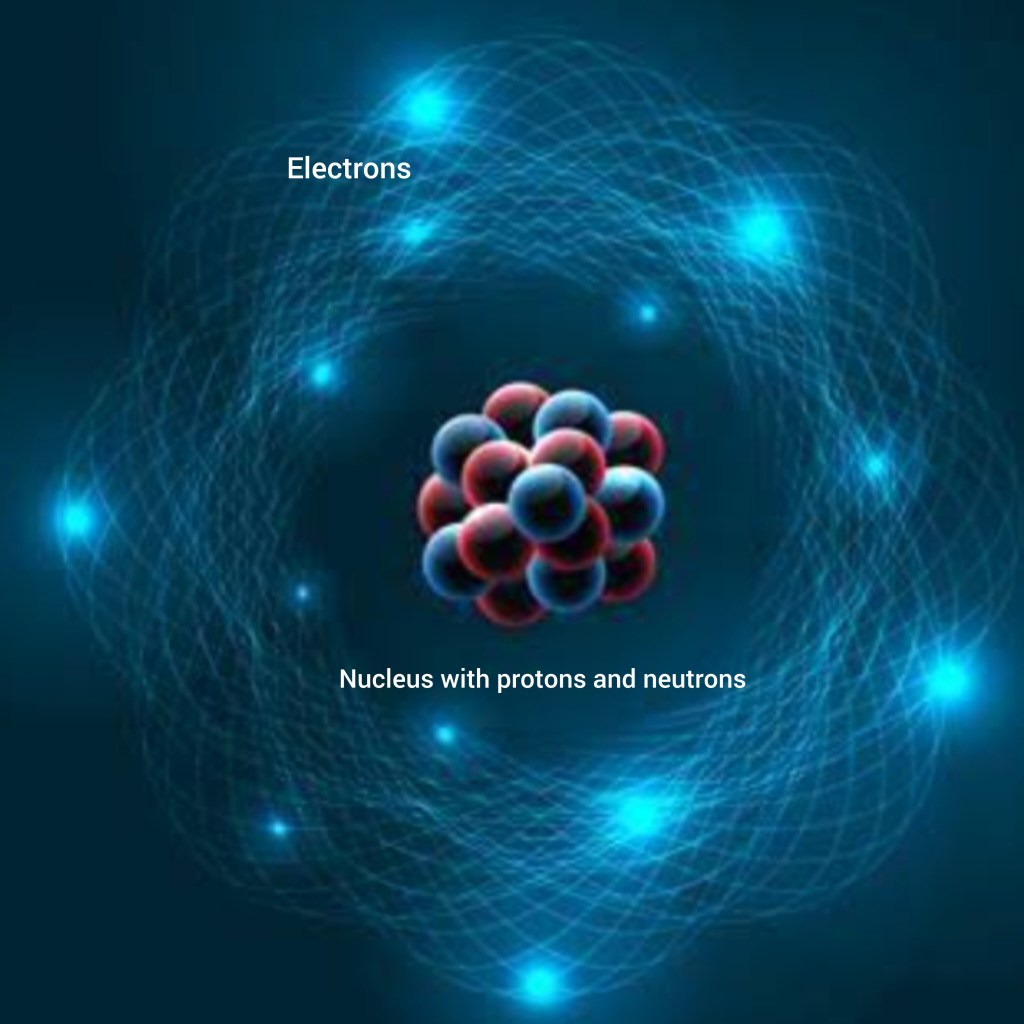
Model of atom in quantum physics The smallest unit of this world is an Atom.Every organic and inorganic matter is made up of atoms. An atom is composed of a nucleus (consisting or nutrons and/or protons) and electron(s) surrounding the nucleus. For a very long time it was beleived that electrons orbit around the nucleus just like planets do around the Sun in a solar system. But the movement of elctrons is not like that. Recently it has been established that electrons actually oscilate or vibrate around the nucleus.
When we recite Mantras vibration is produced. One vibration have the capability to affect another vibration. So when we recite Mantras we affect everthing around us. So with the right Mantras we can very well change the energy field around us to a positive one and make the Universe work in our favour.
And above everything I would like to suggest just one thing. Dont beleive anyone else or this article. Sit alone, close your eyes and chant a Mantra and feel the difference. You can start by a very simple Mantra like “Om Namah Shivay” or even and “Om”.
-
Is Hindi really our National language
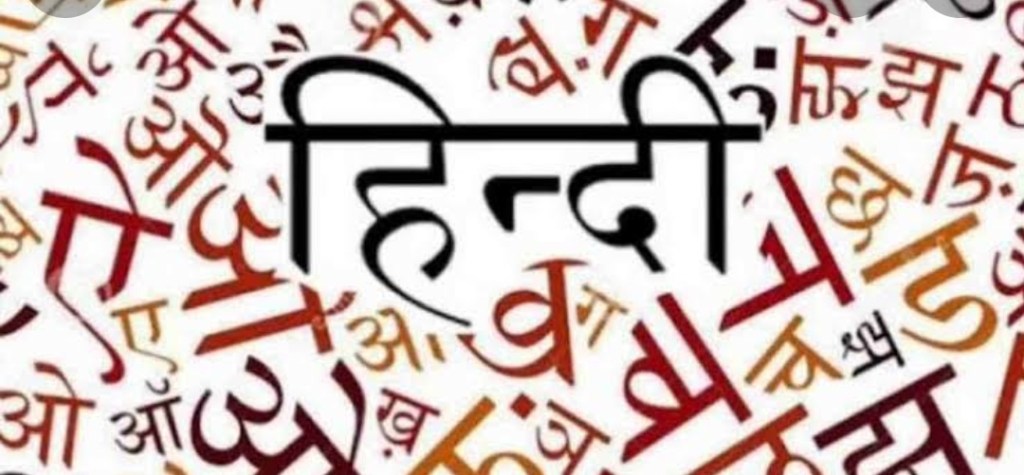
National language or not We all have seen how two movie actors have started an online debate over hindi being our national language. But do you know whether it is true or not? Whether hindi or any other language is the national language of India or not. So before jumping into the battle of national language for proving your patriotism lts just check our facts.
What started the debate ?
Recently at an even, Kannada superstar Kiccha Sudeep, while speaking about the success of movies like RRR abd KGF Chapter 2, said, “You said that a pan India film was made in Kannada. I’d like to make a small correction. Hindi is no more a national language. They (Bollywood) are doing pan-India films today. They are struggling (to find success) by dubbing in Telugu and Tamil, but it’s not happening“.
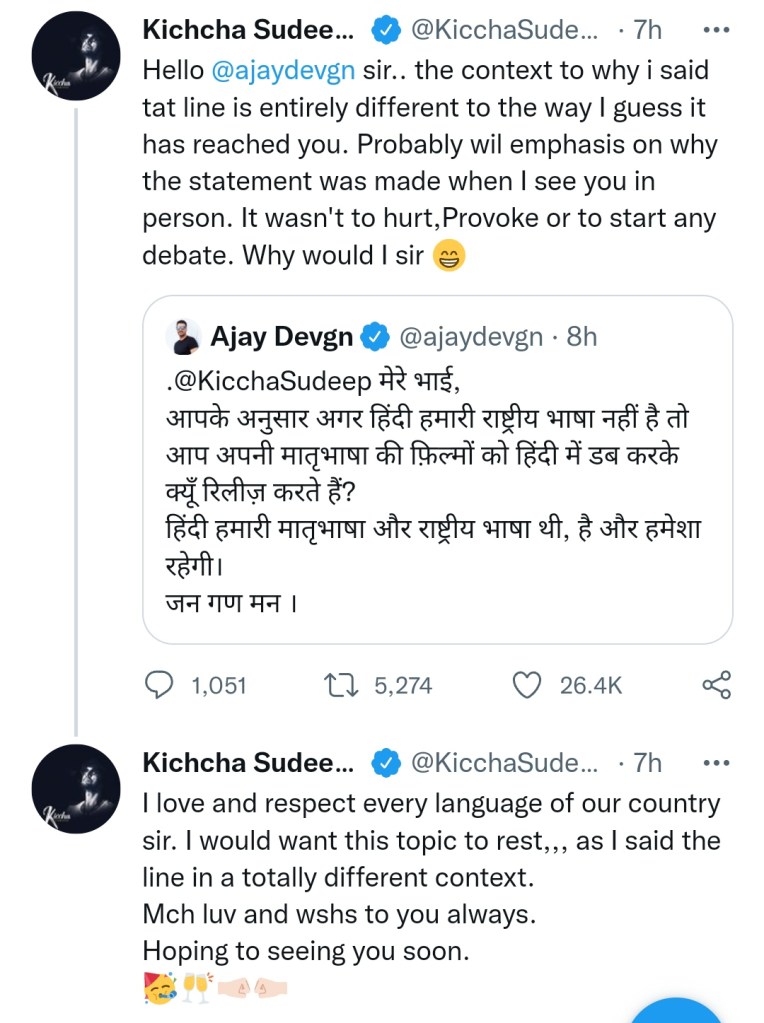
Ajay Devgan took offence to Sudeep’s statement and tweeted in hindi and tagged Sudeep in the same questioning him why South Indian movies are being dubbed in Hindi.
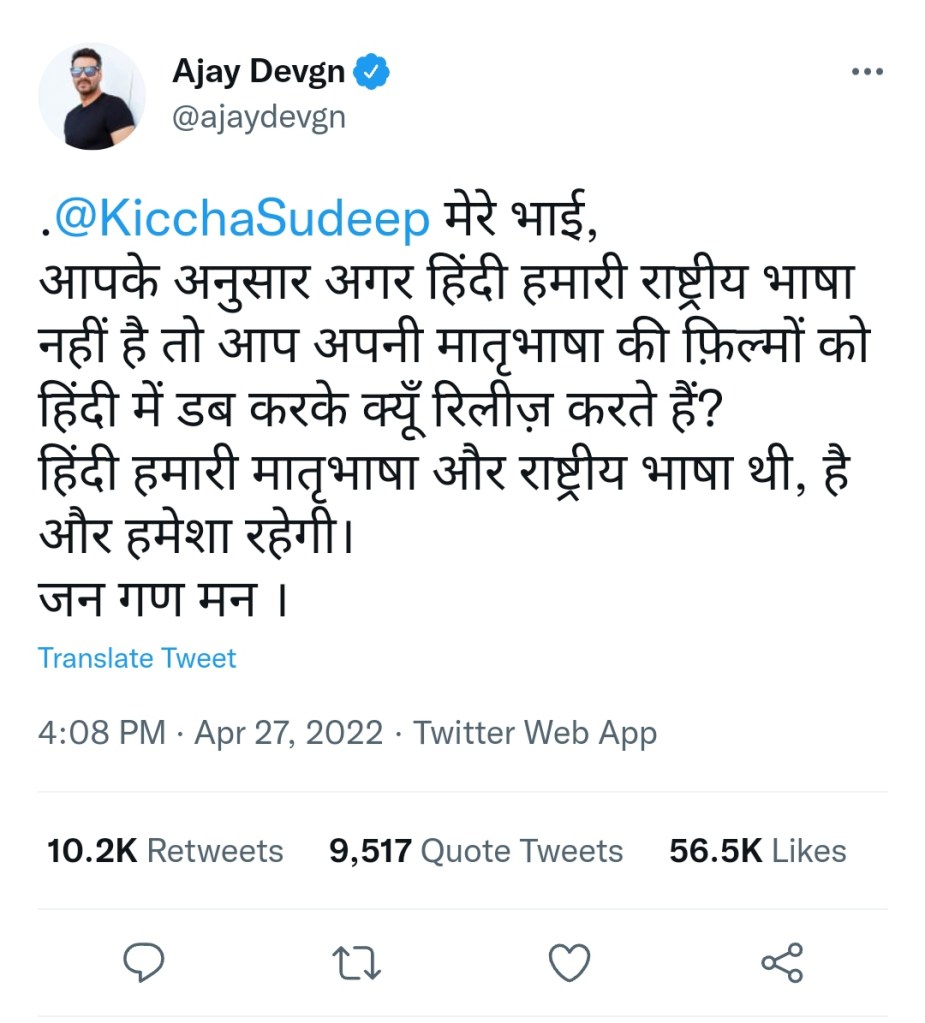
Which language is out National language ?
You will be surprised to know that whole this twitter spat is baseless as Hindi is not our national language. In fact there is no language as National language of India. As per the Constitution of India, there is no National Language of India. After independence, the Constitution makers had a problem of selecting a national language which can unite a country because there were more than 1,600 languages spoken in different parts of the country.
Hindi is in fact our Official language or Rajbhasha. Hindi became the official language of the Union of India in 1950. The Constitution of India provides for the use of Hindi in the Devanagari script as the official language of the Union. According to Article 343, “The official language of the Union shall be Hindi in the Devanagari script.
How ever Sudeep clarified his intentions by replying to Ajay Devgan’s tweet clarifying that he loves and respects every language and Ajay has taken it in a very different context.
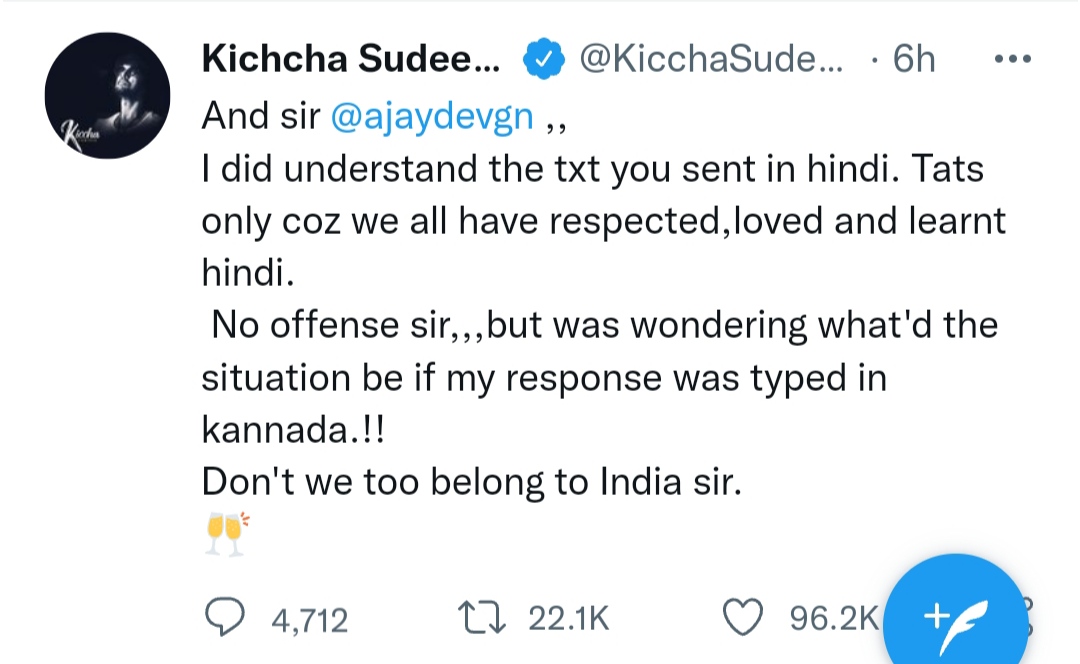
Later on he also gave a befitting reply to Ajay questioning him that if he would be able to understand if Sudeep had tweeted in Kannada mentioned specifically that “we too belong to India sir”.

Its up to you whether you take this stint as an act out of love for Hindi or to whitewash image for being criticized over doing certain advertisements.
-
PM MODI TO INNAUGURATE 108FT STATUE OF LORD HANUMAN TODAY.
According to a statement published by the Prime Minister’s Office on Friday, the monument is the second of four sculptures being created in the four directions around the nation as part of the ‘Hanumanji Char Dham‘ initiative. According to the PMO, the monument has been installed in the west, at the Ashram of Bapu Keshvanand ji in morbi gujrat
Today is Hanuman Jayanti, a great event. At 11 a.m., a 108-foot-tall statue of Hanuman Ji will be unveiled in Morbi. I am honoured to be able to participate in this event through video conferencing,” he tweeted with images of the deity’s statue.
The first statue in the series was built in Himachal Pradesh’s Shimla in 2010, and construction on the third statue has begun in the south in Rameswaram, according to the PMO.
Earlier, the prime minister wished everyone a happy Hanuman Jayanti. “On the birth anniversary of Lord Hanuman, a symbol of strength, courage, and restraint, best wishes to all the countrymen. May everyone’s life be blessed with power, wisdom, and knowledge by the grace of ‘Pawanputra,’” PM Modi tweeted in Hindi.
The festival of Hanuman Jayanti commemorates Lord Hanuman’s birth anniversary. The festival will be held on April 16 this year.
